Guide · 9 min read
How to Write an Instagram Carousel Caption That Gets Saves
A carousel caption that earns saves gives the reader a specific reason to come back to the post, not just a summary of it. Nobody outside Instagram can see saves, so no public data proves a formula. Here is what 130 real captions show, and a five-part structure you can test.
What can a caption actually do for saves?
Be wary of anyone who gives you a caption formula "for saves" with numbers attached. A save is private. The owner sees a count in their own insights, the viewer sees nothing, and nobody else does. Meta's developer documentation defines the metric ("number of times your app user's Instagram media was saved") and notes that insights data is not available for any media inside an album, so you cannot even get saves per slide. We looked for a public dataset linking caption features to saves and did not find one.
What public data does say is about formats. In Socialinsider's report on 21.3 million posts, carousels had a save rate of 0.05% of followers, against 0.04% for Reels and 0.02% for images. So carousels are already the format that gets saved most. The caption's job is to avoid wasting that, and the cover's job is the swipe (see our cover hook patterns). Our working theory is simple: people save things they expect to use later. A caption can name the later.
That is a theory, and we label it as one. Everything below is either what we measured in public captions or a structure we use and have not yet proven.
What do real carousel captions look like?
We read the captions of 130 carousel posts across 18 accounts. The first surprise is the spread. The median caption is 54 words (371 characters), but 45 of the 130 are under 150 characters and 61 are over 400. There is no house length. The second is how the captions begin. Setting aside one account that uses the identical caption on all 12 of its posts, 118 posts remain:
Our own data, October 2026. n = 118 captions after removing one account with a single repeated caption. One account (theaiguyhere) supplies a large share of the "ask" openings because it reuses a template. Categories are keyword rules, so a few edge cases are miscoded.
Three further counts from the same set. 59 captions use no hashtags at all. 48 use exactly five. None uses more than five, which lines up with Instagram's December 2025 announcement that it would gradually cap hashtags at five per post (Social Media Today said the rollout was gradual and gave no completion date). And 20 captions point to a link in the bio.
The ask-first openings are mostly one pattern: "Comment WORD and I will send you ...". We come back to that below. Questions at the start are rare, only 3 of 118, which fits the hook post's finding that the winning covers were statements and labels more than questions.
What is a good caption structure to test?
This is the template our own examples follow, with one change we made after writing this post (the first line). It runs about 40 to 80 words. Short is fine; the cover and slides carry the content.
- Hook line. Say the promise again in different words and add one fact the cover did not give. Our older template copied the cover words, which wastes the most visible line.
- Pain. One line that names what the reader is stuck in. "You sit down every morning wondering what to post."
- The fix. Two to four short lines or numbered steps. One idea per line. This is the part a person scans.
- Save line. One line that names when the post will be useful. "Keep this for your next sales call."
- Call to action. One. Not three. Either a DM keyword, or "link in bio", or nothing.
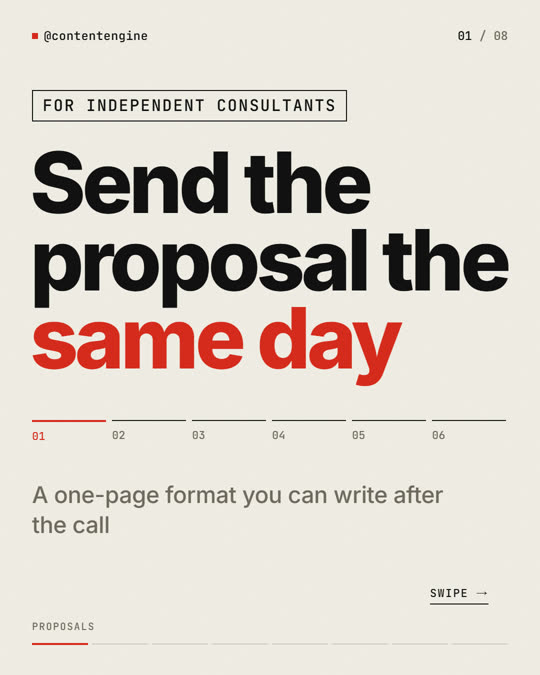
A finished example from our own files, for a consultant carousel about proposals: "Most proposals lose time, not the deal: a week of polishing while the client's attention moves on. The one-page format: their problem in their words, three options with one recommended, plain scope, a date to decide by. You can write it the same afternoon as the call. Save this for your next sales call. DM me PROPOSAL and I'll send the template. #consulting #freelancebusiness #proposals" That is 63 words, three hashtags, one ask.


How do you write the save line?
This is the one part of the caption aimed squarely at saves, so it gets a rule: name the later. A generic "save this for later" gives the reader nothing to picture. Compare:
- "Save this" (an order with no reason).
- "Save this for later" (a reason so vague that it could apply to anything).
- "Save this for the morning you sit down to plan the month" (a reader can see the moment).
- "Save this before your next client call" (names an event).
There is a policy angle too. Meta's page on engagement bait describes it as posts that explicitly request votes, shares, comments, tags, likes or other reactions for purposes other than a specific call to action. The page we opened does not name saves and does not say what enforcement looks like, so we cannot tell you where the line is. Our own house rule is cautious: we write the save line as a use case, and we avoid "comment" and "tag three friends" wording on any account we care about keeping. Treat that as our policy, not as Meta guidance.
One more reason to keep the save line modest: a save is a signal of intent, not proof that the post helped anyone later. We cannot see what happens to a post after it is bookmarked, and neither can you.
Should the caption carry a comment keyword?
This is a different goal from saves, and the public numbers are stark. Among the 115 posts with a visible like count, 40 carry a "comment WORD" style ask (10 accounts) and 75 do not (13 accounts). The median post with the ask had 0.22 comments per like, against 0.01 without it. The accounts differ a lot, so we checked the six accounts that have posts of both kinds. In all six, the posts with the ask had a higher median comments-per-like ratio. Likes went both ways: higher with the ask on three accounts, lower on three.
Our own data, October 2026. n = 115 posts with visible likes. Correlation only: accounts that use keyword asks also run DM automations and may run them on their strongest posts.
The ask makes comments, and it is not obviously a way to make saves. The mechanism behind it is explained in comment-to-DM funnels explained, and it carries a trade-off: on the single account whose posts we compared format by format, posts with a "comment" call to action averaged 178 likes and 154 comments, against 267 likes and 77 comments without one (see carousel vs reel). Use it on a minority of posts and tell yourself which goal each post has.
How can Claude help with the caption?
Captions are the cheapest part of a carousel to delegate, because the content already exists on the slides. Give Claude the slide text and ask for the five parts. This is the prompt we use:
Here are the 8 slides of my carousel: [paste text]. Write an Instagram caption in five parts: (1) a first line that restates the promise in different words and adds one fact not on the cover, (2) one line naming the reader's problem, (3) the fix in three short lines, (4) one line starting "Save this" that names a specific moment when the post will be useful, (5) one call to action: DM me [WORD]. Maximum 80 words, at most three hashtags, no emojis, no claims about results.
Then edit by hand. Read the result out loud and delete anything you would not say. If the model repeats a slide word for word, cut that line; the slides already say it. The full workflow, from idea to rendered slides, is in how to make Instagram carousels with Claude.
What are the common caption mistakes?
- Repeating every slide. The caption becomes a second, worse carousel.
- Burying the one ask. Two or three asks ("save, share, comment, follow") compete, and you cannot tell which worked.
- Changing the format every post. A fixed structure is a feature. One operator in our earlier research posted an identical caption on every one of 11 posts we measured, while engagement ranged from 13 to 2,612 likes. The creative carried the variance; the caption was a fixed template, and it appeared harmless.
- Treating a save count as success. Compare saves per reach against your own median. See how to measure a carousel.
Test one change at a time. Alter the save line on five posts, hold the rest, and compare with the five before. If you cannot see a difference, the caption is probably not your lever, and the hook and the idea are.
Frequently asked questions
How long should an Instagram carousel caption be?
We found no study that fixes a length. In our 130-post corpus the median caption was 371 characters and 54 words, and the lengths were split: 45 posts under 150 characters, 24 between 150 and 400, and 61 over 400. Write as much as the post needs and no more.
Do captions affect saves?
We found no public dataset that links caption wording to saves, because saves are private to the owner. What a caption can do is name a reason to keep the post, which you can test by comparing saves across your own posts.
How many hashtags should I use on a carousel?
Five or fewer. Instagram announced in December 2025 that it would gradually cap hashtags on posts and Reels at five, and none of the 130 captions we collected in October 2026 had more than five.
Is "save this post" engagement bait?
Meta defines engagement bait as posts that explicitly request votes, shares, comments, tags, likes or other reactions for purposes other than a specific call to action. Saves are not named on the page we read. We write the line as a reason ("keep this for your next sales call") instead of an order, which is our own cautious reading, not a Meta ruling.
Should I put a comment keyword in the caption?
It can raise comments sharply, and it is how comment-to-DM funnels work, but it is a separate decision from saves. See our explainer on comment-to-DM funnels before you build one.
The Content Engine researches a niche, writes post ideas and renders carousels (PNG) and reels (MP4) on your own computer. USD 67 one time, 7-day refund. It needs a paid Claude plan (Pro or higher), Node.js and FFmpeg, and we have tested it on Windows only.
See the Content EngineSources and our data
- Meta Transparency Center: engagement bait (definition and exceptions; the page does not state what happens to violating content)
- Social Media Today, 18 December 2025: Instagram will gradually limit captions on posts and Reels to five hashtags
- Socialinsider Instagram Engagement Report (21,286,536 posts, Oct 2025 to Mar 2026): carousel save rate 0.05%, Reels 0.04%, images 0.02%
- Meta for Developers, Instagram Media Insights reference (saved metric definition; no insights for individual media inside an album)
- Our own data: 130 carousel posts from 18 accounts in AI, tech, business and design, captions and public like and comment counts collected logged out in October 2026. 115 posts show a like count; 15 hide it and are excluded from engagement figures. Captions were cleaned of page markup; keyword matching is by regular expression ("comment" as a whole word; 42 of the 43 matches were keyword asks such as Comment FRAME).
- Our own data: the caption template and example captions shipped with our seven example carousels.
Go deeper: how The Content Engine works · pricing and the 7-day refund · compare the options · glossary of Instagram terms · all guides
Keep reading
 GuideInstagram Carousel Hooks: 7 First-Slide Patterns From Real CoversSeven first-slide patterns from the 24 best-performing real covers, plus a ten-minute drill.
 GuideHow to See Saves and Shares on an Instagram Post, and What a Good Save Rate IsWhere to see saves and shares, what you cannot see, and how to judge a save rate.
 ReferenceInstagram Hashtags, Keywords and Alt Text in 2026: What Is VerifiableWhat Instagram documents about hashtags, keywords and alt text, and what is only folklore.
Results vary. No promise of views, followers or income. The Content Engine is an independent product, not made or endorsed by Anthropic. Claude is named only as the tool it runs on.