You already have the material: check-in notes, a client's first pull-up, the question three people asked this week. Paste it in. Claude turns it into hooks and captions in your words, and the templates render reels and carousels you can post between sessions. It works from what you give it, so nothing about your clients gets made up.
"I stopped selling and started marketing."a coach on r/personaltraining ↗
made with the
engine's templates ↗
fitness coaches
Most AI post tools start from an empty prompt box. This one starts by looking at what your niche already rewards, so the ideas come from evidence.
Give it a niche or a list of accounts. It counts what they post, scores each post against that account's own median, and pulls out the hooks of the ones that beat it.
Claude research agents check what the niche already pays for on marketplaces, read public pages and any comments you paste in, and suggest sub-niches worth testing, with sources.
Ideas built from what's working, written fresh for your page. Each one gets a hook, a second hook for slide 2, and captions.
We ran the research workflow on trainers' Instagram grids and on the accounts selling to them, counting the last 12 posts of each. The result decided which format comes first on this page.
Counts come from public Instagram grids loaded logged out in October 2026, last 12 posts per account, pinned posts included.
Fitness coach examples first, then the other niches. Each one was rendered from a template filled with a coaching story. Tap any reel for sound.
These are ready-made looks that ship with the engine. Want a different one? Describe it to Claude and it builds it as a reusable style, tests it on a carousel and a reel, and you refine it together. How it turns out depends on your description, so we don't promise any particular look.
Also see: social media managers · faceless pages · main page
Every tile below is a slide from the examples on this page. Rendering runs on your own machine, so a longer queue just takes longer to render, at no extra cost. On our test PC a carousel took about 2 seconds and a reel about a minute.
We used the engine's research workflow to score 16 professional niches on what sells in marketplaces, what the audience posts, what they say online, and who already sells to them. Part of the result, including the parts that went against us:
| Niche | Paid-demand rank | Verdict |
|---|---|---|
| Social media managers | #10 of 16 | Most buyer talk about paying for help (27%) |
| Church media teams | #3 of 16 | Weekly need, church budgets |
| Real estate agents | #1 of 16 | Buys the most, posts reels |
| Photographers | bottom 6 | Carousel-heavy, spends little |
| Therapists | bottom 6 | Skip |
marketplace listings read, with checks that each shop really sells to that niche
posts and comments from niche communities, scored by a local AI model
niches checked. Each number traces back to a page we loaded, and the ones we couldn't verify are marked that way in the notes.
| Option | What you get | Year one |
|---|---|---|
| Done-for-you content membership e.g. a realtor content club | Monthly templates you still fill in | $888 $74 / month |
| Freelance designer | Design work per post | varies per post, per revision |
| The Content Engine | Page analysis, niche research, carousels, reels and captions, as many as you make | $67 once · $0 per post |
Source: Coffee & Contracts membership page ($74/mo). You need your own Claude plan to run the engine.
Studies the Instagram accounts in a niche: what they post, how each post scores against that account's own median, and the hooks behind the ones that beat it.
Claude research agents look into a niche and its sub-niches: what it already pays for on marketplaces, plus what public pages and the comments you paste in say, with a source link for each finding.
Turns the research into a queue of new ideas, each with a hook, a second hook for slide 2, and captions.
Feeds your idea queue into data-driven templates and renders the carousels and reels on your computer, the whole queue in one run.
Any look you can describe: "soft pastel with paw prints", "black and neon, salon luxury". Claude builds it as a reusable style for every post. A few ready-made looks come with it as starting points.
Original music and sound effects generated in code, plus optional voiceovers from a free voice model that runs on your computer (needs Python and a one-time download of about 1 GB).
What we learned testing it: slide 2 rules, safer call-to-action wording, and claims to keep out of your captions.
Post on your own pages or your clients'. What you render is yours.
A step-by-step install guide (tested on Windows; Mac not yet tested), written for people who haven't used a terminal before.
Only with their written permission. The engine works from the notes you paste in and doesn't make up results, names or numbers. Leave out anything a client hasn't agreed to share.
Yes. Reels are what trainers post most, so they come first. A client win can become a reel, a carousel and a few captions from the same notes.
It rewrites your material into posts. It isn't a coach, so check every claim before you post it, the same as you would with a ghostwriter.
Collect notes during the week, run one batch, and review the posts in one sitting. Rendering runs on your computer while you train clients.
It looks at public profiles the same way you would, logged out: what each account posts, how often it uses carousels or reels, and how each post scores against that account's own median. It reads public pages only. It doesn't post, follow or like.
Claude research agents read public sources: marketplaces where the niche already buys, public pages Claude can open, and any comments or posts you paste in. Each finding comes with its source link so you can check it yourself. It is research help, not a guarantee that a niche will sell.
The ideas come from research into your niche and are written fresh for your page, and the templates rotate layouts across a batch. You can change any template. Two buyers in different niches start from different research, so their queues differ too.
As many as you queue. Rendering runs locally, so a longer queue takes more time and nothing else. On our test PC that was about 2 seconds per carousel and about a minute per reel; slower computers take longer.
Most looks you can describe in colours, fonts, backgrounds and motion. Claude builds it as a reusable style: it starts from the closest ready-made look, changes the colours, fonts, backgrounds and motion, renders a test carousel and reel, and adjusts it with you. Ready-made starter looks are included, such as: Pixel Arcade, Studio Pop, Volt, Paperclip, Warm Cinema and Minimal Mono. How close it gets to what you have in mind depends on how clearly you describe it (screenshots help), so we don't promise any particular look.
No. You tell Claude what you want and it runs the engine, asking you to approve each command. You need a Windows computer (tested on Windows; Mac not yet tested), a paid Claude plan (Pro or higher) and an internet connection. Setup means installing a few free tools (Node.js, FFmpeg and Claude Code) by following the guide, about 20 to 30 minutes once.
Nothing extra from us. There are no credits or per-image fees. Research and ideas use your paid Claude plan (Pro or higher), so big research runs count toward that plan's usage limits, and rendering runs on your computer.
Yes. What you render is yours to post on your own accounts or your clients'.
No. It makes finished files (carousel PNGs, MP4 reels and a captions file) that you upload or drop into your scheduler.
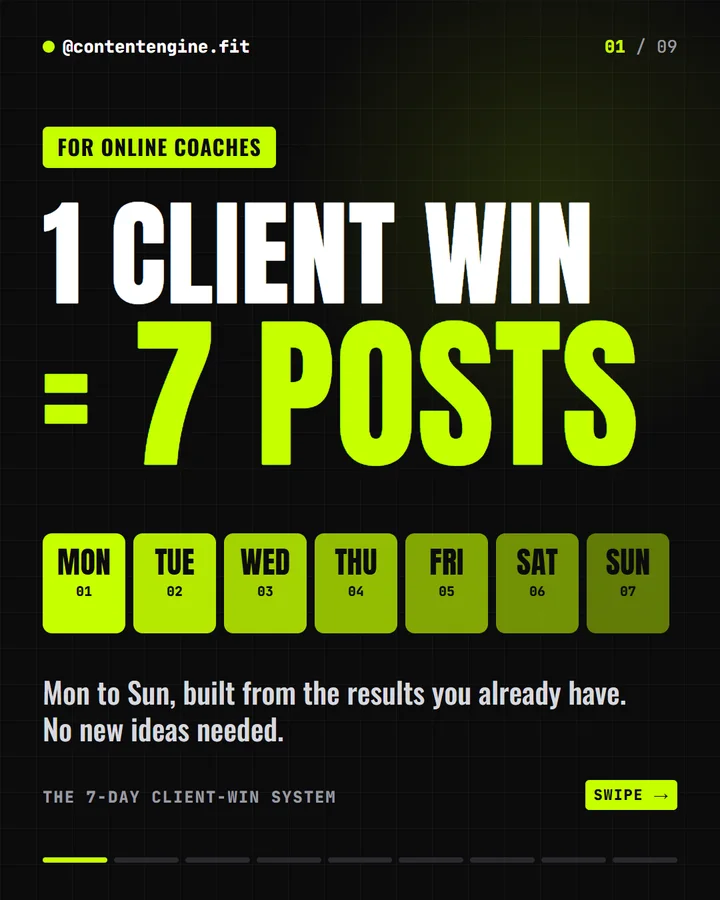
The research, slides and reels on this page were made with its workflow and templates. Point it at your niche next.
once · not monthly
Founding price: $47 for the first 25 buyers, then $67.
Bonus: the Viral Post Kit (editable post templates and 100 fill-in hooks, a $19 value) is included.
Needs a paid Claude plan (Pro or higher). 7-day refund, no questions asked.
Get the engine, $47Last updated: